Showing posts with label weedle. Show all posts

Thursday, September 26, 2013

EP004 - Challenge of the Samurai


EP004 - Challenge of the Samurai

Original Airdates: April 22, 1997 (JP), September 11, 1998 (EN)
Written by: Hideki Sonoda

Synopsis:

Still travelling through the Viridian Forest, Satoshi attempts to catch a Weedle, but it escapes when a strange trainer who calls himself “Samurai” challenges him to a battle.  In the middle of a Metapod vs. Metapod standstill, a swarm of Beedrill attacks, interrupting the fight.  Satoshi’s Metapod gets kidnapped by a Beedrill and ends up in their nest.


Satoshi and Kasumi spend the night in Samurai’s cabin to stay safe, but Satoshi feels bad for abandoning Metapod.  The next day he rescues Metapod by infiltrating the nest and it evolves into Butterfree.  Butterfree uses Sleep Powder to quell the swarm, allowing our heroes to escape.  Samurai considers the prior battle a victory in Satoshi’s favor and leads them out of the forest.

Who’s That Pokémon?
It's Metapod, because Ash abandons his Metapod (and battles another Metapod).

New Character and Pokémon Breakdown


Ash's Butterfree

Part 2 of the Ash's Butterfree saga focuses on its Metapod stage.  Being an immobile pupa, Metapod cannot battle well or defend itself in trouble.  As a result, Ash is forced to leave it behind, giving the creature severe abandonment issues.  Just because it hasn't reached its full potential, it feels inferior.  Fortunately, it is able to induce an early evolution when he sees its trainer in trouble, much as Pikachu finally came through for Ash against the Spearow.  As a Butterfree, he can finally prove that he's a capable fighter...yet he all but disappears after this episode.

Samurai

We meet our first “Character of the Day,” which is a character that only appears in one episode and never comes back, despite promises to return.  Samurai is a memorable COD because he introduces the concept of legal Pokémon battles (not just random Team Rocket attacks).  He is based on the Bug Catchers of Viridian Forest who are the first Trainers in the games (besides the rival).  Usually the problem with COD’s is that they are only there to showcase the Pokémon of the Day making those episodes seem rather meaningless.  Samurai does introduce a new Pokémon (Pinsir) but his Pokémon are not the focus of the episode.  The main plot revolves around the wild Beedrill and Satoshi’s Metapod.  Samurai is a source of chaos unto himself and he is there to put Satoshi’s skills to the test.

Samurai's Pinsir and Metapod

Somehow, the Samurai managed to get a Pinsir this early in his journey (maybe its his starter).  But despite its vast strength, it is still able to be taken out by a Metapod.  Kind of lame (but cool, at the same time).  The Metapod vs. Metapod Hardening battle, however, is a funny concept, but useless to the point of being a little contrived.  What were the Trainers expecting to happen?  Satoshi’s Metapod at least knew Tackle, so the battle could have gone somewhere.  But there was no point in prolonging the standstill.

Weedle, Kakuna, and Beedrill

Ash nearly catches a Weedle, but Samurai disrupts his concentration and the Weedle manages to escape (and possible alert the nest of Beedrill).  We later see more Weedle at the Beedrill nest, eating Team Rocket's...cardboard vehicle?  The Kakuna and Beedrill, like the Spearow, are just forces of nature, bent on destroying anything that disrupts their rest and privacy.  With all of these dangerous Beedrill around, its a wonder anyone makes it through Viridian Forest alive.

Bulbasaur, Charmander, and Squritle

In static flashback shots, we see that starter Pokémon that Oak handed out too the other three trainers from Pallet, each one battling with the Samurai.  At this moment, though, we still don't know which one Gary started with, so don't spoil it please!

Japanese vs. American Versions:

- Most jokes are rewritten to moderate effect, but the oddest one is Ash dressed as a cow saying “Cowterpie?” because in the original “Mushi (bug)” is similar to “Ushi (cow).”

Overall Review: A-
            
The humor from the previous episode continues here, as Satoshi and co. find themselves in sillier situations (like the intense little boy who demands to fight with honor).  Team Rocket is used nicely in that they are purely comic relief and they do not overstay their welcome.  By insisting on completing their motto which results in waking the Beedrill, they present a funny variation on the now recurring motto gag.

Once the drama kicks in, things begin to get a little uneven.  The abandoning Metapod plot comes a little out of nowhere.  Satoshi is so upset with himself, but, he really had no other choice.  He would have gotten himself killed had he tried to save Metapod earlier.  He acts as if he was a horrible person who made many mistakes, but it really was just the one.  And, despite what Samurai would have him believe, Weedle getting away was totally Samurai’s fault.  Satoshi needn't be so hard on himself.  But he grows.

My favorite aspect of this episode is the attention to detail given to the various Pokémon, treating them like actual animals rather than completely fantastical creatures.  The sights of Kakuna and Metapod evolving are quite stunning as they actually break out of their hard shells as opposed to glowing and transforming.  I wish later episodes had kept this dynamic.


This is a very well-balanced episode and it shows a level of quality and attention to detail of both the characters and the world around them.  It's a solid and funny episode that moves along quickly and develops Satoshi’s character in a positive way.

Tuesday, September 24, 2013

Route 2 and Viridian Forest


At this point, we only have access to the western half of Route 2.  Outside of a few patches of grass (with redundant Pokémon), there is nothing of interest on the actual route itself.  But once you pass through the building, we encounter the first "dungeon" of the game: Viridian Forest.

Viridian Forest is big, long, filled with poisonous Pokémon and trainers who automatically battle you.  If you aren't prepared, you could fall here.  Make sure to pick up items you find laying on the ground and be sure to add to your collection.  This is probably the closest part of the game to Tajiri's initial idea of Pokémon, searching in the woods for bugs.
 Caterpie - Lv. 3-6 - Red/Green/Blue/Yellow 

While you can first catch them on Route 2 in Green/Blue, you'll be seeing these guys everywhere in Viridian Forest.  You can also find their evolved form, Metapod, but it will only know Harden, making it difficult to battle with.  It's better to evolve it from a Caterpie so it can continue to fight with Tackle.  If you want a Butterfree, go right ahead and catch a Caterpie.  Butterfree will be useful once it learns Confusion, as it can take care of Pewter Gym and Mt. Moon.  But save for a battle against Erika later, Butterfree won't be cutting it as a long-term teammate.  He's a must catch in Yellow though, as he learns all of his moves earlier and helps with the trickier sections.
 Weedle - Lv. 3-5 - Red/Green/Blue 

Weedle is most common in Red, appearing on Route 2 in addition to the Forest, and it doesn't appear at all in Yellow (another reason why you should pick up a Caterpie there).  Like with Metapod, Kakunas also appear in the Forest.  Despite having the great Twineedle attack upon evolution, Beedrill can't really handle anything aside from Erika (maybe it can get a quick hit in on Sabrina, but it won't last long due to its part-Poison typing).  Again, you can catch both bugs, or choose your favorite, but Caterpie probably would be the stronger decision of the two.
 Pikachu - Lv. 3-5 - Red/Green/Blue 

While rare, Pikachu can be found in the Viridian Forest for non-Yellow players.  While he doesn't learn as many level-up moves as his Yellow counterpart, he can do quite well with the library of TMs.  Plus, this Pikachu can evolve into Raichu, making him much stronger in the long run!  Ultimately, you'll probably keep Raichu on your team all the way to the end (helping you through Seafoam Islands and against Lorelei), which can't be said for the starter Pikachu.  It provides some great balance to your team early on, so it's worth sticking around in the Forest in order to find one.

In addition to some new Pokémon, we also get to meet our first average trainers!  They come in multiple varieties and each class has an identical sprite, making them similar to Nurse Joys, Officer Jennys, or Pokémon themselves!  As a result, you'll have similar tactics for battling each type.

 Bug Catcher 

This is our first encounter with a common trainer.  Bug Catchers basically carry stronger versions of the wild bugs found in the Forest.  In Red/Green/Blue, you'll find their collective teams consist of one Caterpie, one Kakuna, and four Weedles, with the final Lv. 9 Weedle being the strongest opponent in the Forest.  Yellow Bug Catchers have a different arsenal, to reflect the lack of Weedles.  They instead have three Metapods and five Caterpies, with a Lv. 10 Caterpie now being the final challenge.  Although there is an additional Catcher added (possibly as a reference to the Samurai character from the anime) the challenge is lowered as Caterpies and Metapods go down a lot easier than Weedles (save for the additional Catcher's Metapod that actually knows Tackle).

 Lass 

Yellow players get another additional trainer in the Forest.  Lasses usually appear slightly later in the game and carry common Pokémon.  This Lass has both a male and female Nidoran and for a while, I struggled to understand this addition.  Unlike most of the changes in Yellow, this is not a reference to the anime.  But I realized that since Nidorans are crucial for Yellow players to defeat Brock, it serves as a hint to new players who may have missed out on the early Nidoran to retrace their steps and catch one.

Once you're through the Forest, your next stop is Pewter City.  We'll return to the hidden goodies on Route 2 once we have traveled across the map and received the necessary items.

Other Thoughts

- Replacing the Weedles, Kakunas, and Pikachu, Yellow players get more Pidgeys and a Lv. 9 Pidgeotto available for capture.  This is to mimic the anime, where Ash caught his Pidgeotto in Viridian Forest (although there were also Weedle and Kakuna there too).  As I said before with Pidgey, you're better off sticking with Spearow, although Pidgeotto is a stronger option than both, stat-wise.  It will still take a while to be useful, but at least you don't have to wait for the first evolution.

- Although it doesn't effect this stage of the game, much later we'll see evidence in other canons of Viridian Forest stretching all the way over to Celadon territory.  If you look at the map, you'll see that it's nothing but uninhabited forest between the two.  I would have liked for a pathway to open up connecting the two later in the game, possibly revealing a new part of the forest that had stronger Pokémon (as seen in the various manga and anime).  In Hey You, Pikachu, this area is revealed to be home to quite a few different types, including a Togepi!  But I'm getting ahead of myself.

Wednesday, September 18, 2013

Card of the Day: Base Set Beedrill


HP:  80   Retreat Cost:  0   Weakness:  Fire   Resistance:  Fighting

80 HP is a little low for a Stage 2 Pokémon (considering it doesn't gain health through evolution), but a Resistance and no Retreat Cost are wonderful additions that help balance the creature.  (Apparently, the designers saw the wings and assumed Beedrill gets the standard Resistance that all Flying-types receive.  I'm not complaining.)

Twineedle (3C):  30x

This is Beedrill's standard attack.  Nothing special, outside of the Colorless cost, which means that Beedrill can assist in non-Grass decks.  And the chance of hitting 60 damage is nice, but I would stick with the more reliable Poison Sting.

Poison Sting (3G):  40

40 for 3 Energy is already a good deal, but the possibility for Poison makes this attack even better.  I once foun myself in possession of 4 Beedrills, and I realized that I could cause so much havoc just by Poison Stinging all of my opponents.  One Beedrill alone may not do the trick, but multiple working together can be a nightmare.

Strategies Against Beedrill

Take out the Weedles as soon as you can.  Kakuna will not fall down easily, and once Beedrill is in play, make sure you have some Full Heals on hand.  Fortunately, the weak HP means a Basic or Stage 1 Fire Pokémon like Charmeleon or Magmar can take it down.  But you have to make sure that you strike it down in own fell swoop, because it can retreat without penalty if it is in danger.  Unfortunately, not many non-Fire types can consistently deliver 80 damage points.

Kakuna Overview


HP:  80   Retreat Cost:  2   Weakness:  Fire   Resistance:  None
Kakuna's primary goal is to stall until Beedrill is available.  With a whopping (for a Stage 1 Pokémon) 80 HP and Stiffen, which can prevent damage, Kakuna can hold on for a long time.  Poisonpowder is just a weaker version of Beedrill's Poison Sting, but at least it can ensure that your opponent is taking damage while Stiffen is guarding Kakuna.  Kakuna is a well-oiled machine and staller for any Grass deck.  C+

Weedle Overview


HP:  40   Retreat Cost:  1   Weakness:  Fire   Resistance:  None
Weedle is the Beedrill's weak spot.  It can set up an early Poisoning with Poison Sting, but it won't last beyond 3 rounds.  Among the Basics it will be encountering early on, it is one of the weakest choices.  Better keep it on the bench until it is ready.  D-

Sample Beedrill Deck

You'll want many Beedrills attacking in full force.  In order to stall and protect the Weeles, I've enlisted some Seels and Staryus.  The Staryus can take out weak Fire Pokémon while the Seels are mini-walls.  And Dewgong is a powerhouse unto itself.  But with up to 4 Beedrills flying, they will experience little hassle.

4 - Beedrill
4 - Kakuna
4 - Weedle
2 - Starmie
3 - Staryu
2 - Dewgong
3 - Seel
4 - Bill
3 - Pokémon Trader
4 - Energy Removal
3 - Professor Oak
12 - Grass Energy
8 - Water Energy
4 - Double Colorless Energy

Final Grade: B+

As much as I enjoy Beedrill, I must admit that there are stronger Pokémon out there.  If you use the Poison well and time your Retreats perfectly, then Beedrill can be an annoying battler to come up against.  The weak Weedle is really the only thing holding this back from "A" territory for me, though.  Give Beedrill a try.  It's worth it.

Monday, August 26, 2013

Capsule Monsters

Bulbapedia Article (All images borrowed from Bulbapedia)

When I was 10, I began my Pokémon Journey.  On September 1st, 1998, the Red and Blue Versions were released for Game Boy and the first episode of the anime debuted in America.  My very first memory of the series was a simple magazine ad that showed a collection of the creatures with the phrase "Gotta catch 'em all."  Even as a child, I understood that this was a marketing ploy built on hooking kids into a large franchise, but it was so different and foreign to what I was used to that I distinctly remember saying to myself, "Pokémon?  That'll never catch on."

Weeks later, I'd be eating my words.  And so, with the 15th anniversary of my relationship with this series fast approaching, I've decided to go back to the beginning and actually take a look at every single aspect of the franchise.  I'll be reviewing the episodes, the mangas, even the characters themselves in chronological order, basically reliving the series as it was presented to the world.

That means, for the time being, we'll only be looking at Generation I games and Pokémon   So let us go back to the very beginning.

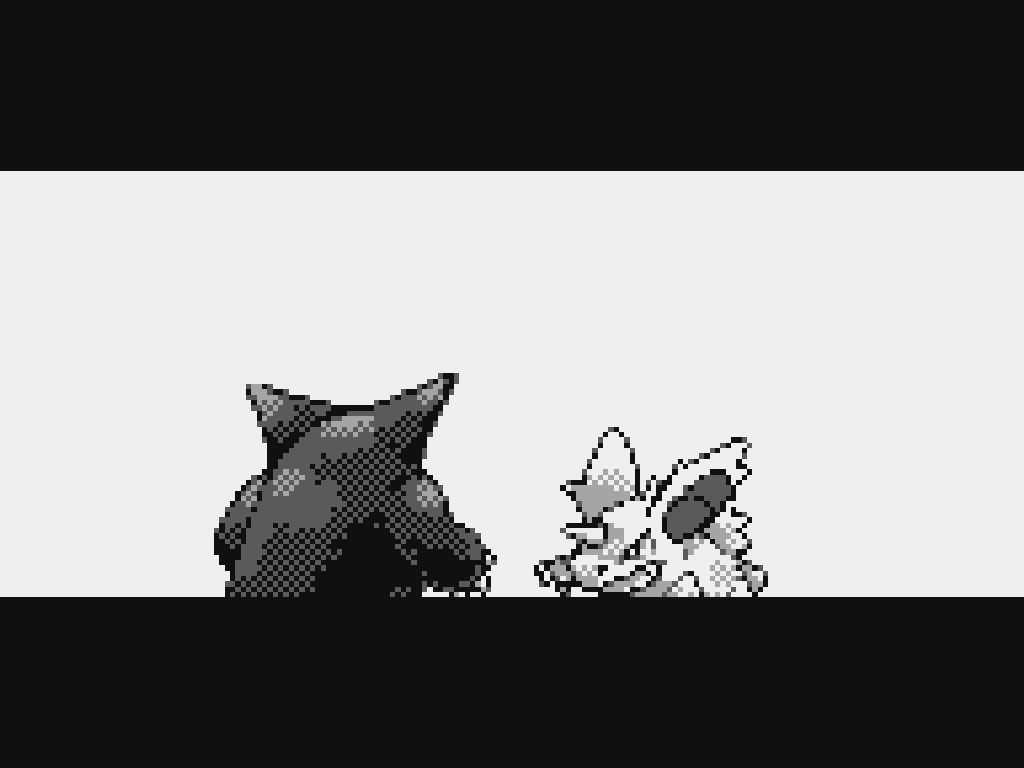
Gengar and Nidorino fighting it out.  Although the logistics of the battle make no sense, what with Gengar being a Ghost type and invulnerable to most of Nidorino's moves, we can see that...wait...

We can go further back than this....


Ah, there we go.  The original Gengar/Nidorino battle.  The first page of Satoshi Tajiri's proposal for what would eventually become Pokémon.

A Monster in my Pocket

Based on Tajiri's childhood love of bug collecting, the driving idea behind the games would be to collect as many creatures as possible. These beasts would be based on realistic and mythological elements to create a fantastical, yet familiar setting. As seen in some of the game's beta data, the earliest "Capsule Monsters" seem to stem from this idea. We have a trio of bug creatures (which seemed to influence the Weedle evolutionary line), some frog creatures that eventually became the Poliwag line, and a dragon that looks strikingly like Dragonair.


The early "Weedle" and "Poliwag" trios show that the metamorphosis-inspired evolution element was in the works from the get go (although "Poliwrath's crown" wouldn't be used as an evolutionary device until Generation II). Because these were based on animals that actually underwent biological changes, the fit seemed natural. The more spiritual "Dragonair" seems to stand on its own at this point, and isn't part of a larger family, suggesting that the evolution aspect was originally only considered for actual shape-changing animals.


The name "Capsule Monsters" or "CapuMon" were based on Japanese gashapon machines which dispensed goodies in plastic capsules. Since many monsters were planned for development, it would make sense for a trainer to have a device to carry them around in. Monsters would shrink to fit in these capsules, and could easily be stored in one's pocket. Due to the "Capsule Monster" name being in use by another company, the name was eventually changed to "Pocket Monster" or "Pokémon," and the capsules became "Poké Balls."


With so many monsters to capture, Tajiri wanted to give players the feeling that they couldn't complete this task alone. Having seen the Game Boy's Link Cable device and imagining bugs traveling along from one system to another, Tajiri knew that this device would have a role in enriching the experience of catching them all. Originally, Pokémon was just supposed to be one game, with many rare "Mirage Pokémon" serving as the catalyst to trade with friends. However, two different versions of the game were made to ensure that players had to use the Link Cable at some point if they chose to complete their collection.

Exploring the Countryside


In addition to collecting creatures, Tajiri wanted to give players the feeling of exploring the world just beyond their own backyard. Similar to the Mother/Earthbound series that was also in development, the exaggerated world of the mundane would become the main setting. Not only that, but the actual layout of the games map would be based on the Kanto region of Japan, with major cities and towns corresponding to real world locations (including starting the player off in Tajiri's own "hometown").


The towns would create a sense of familiarity to the player. A timeless aesthetic was reached as elements of many eras were folded into one. Much as Tokyo was becoming the epicenter for technological breakthroughs while the outskirts of the region remained rural and simple, so did the towns in the game balance the past and future of Japanese life. Astounding computers could perform feats only found in science fiction, yet people are forced to walk or ride their Pokémon instead of use vehicles. It was as if the inclusion of these creatures had a much greater impact on the world than simply being used for competition.


To travel from city to city, the player would have to cross oceans, mountains, and forests. Traveling through the wilderness gave a greater sense of adventure and exploration to the series, making it feel as if we really had left our modern world behind. The image of the trainer exploring a cave with his Rhydon struck me as particularly powerful as it invokes a scene akin to Maurice Sendack's Where the Wild Things Are. This is exactly the feeling Tajiri aimed for, and he succeeded, despite the graphical limitations of the Game Boy.

A New Style of RPG

Capsule Monsters was originally envisioned as a straightforward RPG, with the trainer being the lead attacker and the creatures being the support system.  A relatively small number of creatures was imagined, with Rhydon, Lapras, and Clefairy being the first creatures planned.  Rhydon and Lapras would be the heavy lifters, able to carry items/people.  In fact, surfing on Lapras has always remained the iconic water travel image, even though many Pokémon could have this ability.


Clefairy was more of a "pet" Pokémon  which allowed the developers to realize that the more creatures they could include, the more personal the experience.  Instead of building a small guild to take on a big boss, players would battle each other with completely different teams.  Pokémon would become friends with the player, and in turn the player could give them their own abilities and nicknames.  The reason the final game had only one save file was to allow people to name every single Pokémon they caught.  Ultimately, almost 200 creatures were thought up and programmed, with 150 making the final cut (151 if you include designer Shigeki Morimoto's hidden Mew).

Once the idea of collecting monsters and exploring the world with them was set in place, Tajiri's team added the final piece of the puzzle: an RPG-style battle system. The idea of creatures fighting had created some controversy from day one and it can even be seen in these early sketches that a more violent relationship between trainer and animal was intended from the start. Ultimately, the battles would be viewed as more of a form of "magical wrestling" where healthy competition and fanciful abilities were used to knock the opponent into submission.


In this series of sketches, we see images of how the battle would play out via artistic interpretations. The proto-Gastly/proto-Slowbro and proto-Blastoise/proto-Staryu battles convey the idea that the creatures are more like spirits and mythological beasts, capable of responding to human control, but also enjoying the battle themselves. Of course, Gastly always has that smile...


The proto-Mart for example shows that it sells both the capsules as well as creatures, suggesting they were envisioned as more of a pet store than a simple supply shop.   The trainer is buying the Lapras we saw earlier.  Smaller "Rhydons" are seen here, including an embryo version of one.  Perhaps these are all just placeholders for later creatures, but this bizarre market step up is definitely an intriguing "what if?" scenario.  Also, we saw earlier that a proto-Rhyhorn is walking through the town. It's unclear if the evolutionary connection to Rhydon was made at this point, as we also see similar creatures in cages and hatching from an egg in the other images.


Another major change that stemmed from these early images was the Hotel. Many RPGs use an inn as a place for the party to rest/heal completely during travels. It appears that a similar idea was to be used for the games as the female trainer is seen placing her capsules in a healing device next to her bed. This was of course changed into the more medical Poke Center, although it always bothered me that there was no places for the trainer to rest in the games. An inn would have made more sense. And, if you're familiar with your Easter eggs, you'll recall the hotel in Celadon City that is set up like a Poke Center and even holds an invisible P.C., meaning that hotels probably existed further into development than just these pictures.


Here's a great Tumblr with a lot of beta Pokemon art and analysis.

A deeper analysis with staff interviews can be found at GlitterBerri's Game Translations.

Yes, from the very beginning, the concept of Pokémon was clear.  And, after a few alterations, the game series would become the juggernaut we know and love today.