Showing posts with label gengar. Show all posts

Monday, September 23, 2013

Pocket Monsters: PM007 and PM008

PM007 - Get Rid of the Ghost Pokémon!!

Synopsis:

Traveling through Lavender Town, Red's group gets caught in a thunderstorm.  They seek shelter in a giant, spooky mansion that is filled with gravestones.  Clefairy discovers a coffin and a Gastly appears from it.  It tries to get the trio to leave, but Clefairy attempts to fight it.  However, none of Clefairy's attacks are able to affect the transparent ghost.
Clefairy ultimately succeeds in exorcising the spirit and his approached by an older couple who own the mansion.  They explain that their son Blue has been haunted by Ghost Pokémon and would like Red to complete the job of expelling the phantoms.  They meet the melancholy Blue who attacks with his Haunter.  The Haunter eventually evolves into an invisible Gengar, but Clefairy is able to use Blue's Silph Scope to see the ghost and lull it to sleep.  After vacuuming up the spirit, Blue is revived, but still angry at Red for damaging his room.
New Character and Pokémon Breakdown

Blue

Since Red and Green were based on the heros of Red and Green, a new character was needed to represent the new Blue version.  While Pokémon Adventures used the official female trainer, Anakubo created a completely new character who is obsessed with the color (and emotion) blue.  He is inserted into the Pokémon Tower segment from the games, possessed by the various Ghost types.  He'll reappear a couple of times as another rival for Red, actually owning his own Pokémon.

The Ghosts: Gastly, Haunter, and Gengar

Gastly first appears and attacks of his own free will, while Haunter/Gengar appears to be under Blue's control (even though he is under their control).  Like Charmander's evolution into Charizard, Haunter is commanded into becoming Gengar, making evolution more like another attack.  The ghosts behave mostly the way they do in all canons, being mischevious spirits that can disappear at will.  Clefairy actually has to use an elaborate statue of Buddha to exorcise Gastly, and it works, suggesting that these Pokémon aren't only effected by other Pokémon moves.

Blue's Parents

Unlike in the games, Pokémon Tower is actually a residence for Blue's family.  There are still many gravestones and crosses, which may be explained in the dialogue but I'm just guessing.  I wonder if Blue's father is also supposed to represent Mr. Fuji.  If Mr. Fuji doesn't appear in this manga, I'll assume that they are one and the same.

Setting
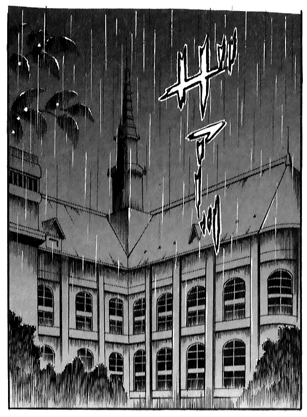
Lavender Town and Pokémon Tower

As stated earlier, the Tower is more of a mansion, but the creepy atmosphere from the games is carried over into this story.  We don't see the rest of the town's inhabitants, though, so it's unclear if everyone is aware of the ghosts, or if this is just an isolated incident.

Overall Review: A-

Aside from creating a new character, the actions of this story are very streamlined with their influence from the games.  The ghosts behave based on their Pokédex entries, and the Silph Scope even comes into play as a helpful plot point.  The story also gets started a lot quicker with less Clefairy/Pikachu antics (save for lightning bolts being attracted to Pikachu's tail).  The story makes sense and the "horror" aspect is not lost, although the scariest moments are the grotesque faces that Clefairy and Pikachu make throughout their encounters with the ghosts.  With little filler and a solid tale, I have very little issue with this issue.


PM008 - Catch That Pokémon Thief!!

(Note: From this point forward, I shall be reviewing the issues somewhat blindly.  I haven't found any thorough translations for the rest of the series, so my analysis will be based on the stories I believe the images are portraying.  Wish me luck.)

Synopsis:

After traveling for days, Red discovers an oasis in the form of the Celadon Department Store.  Brimming with activity and goodies, Red prepares to go on a shopping spree.  Unfortunately, a Machoke crashes into the story with a small army of Pokémon and attempts to rob it.  Clefairy steps up to defend the store and uses the items available to him to help foil the robbery.  First, he gets rid of the Bug Pokémon by spraying them with a repel.
Then he attempts to tie them up, accidentally grabbing Ekans as a rope.  Ekans attacks and Clefairy is able to use an antidote to stave off the Poison attacks.  Finally, the Machoke challenges Clefairy by evolving into Machamp.  Clefairy manages to hide in on a shelf of Poké Dolls and attack him as a surprise.  Ultimately, he tries to use a bicycle to tire out the Machamp.  Red then tries to catch the Pokémon, and finally succeeds by using an Ultra Ball.  The store is saved, but Clefairy's bike ride has carried him to a far away desert.
New Character and Pokémon Breakdown

Machoke/Machamp

Red finally catches another Pokémon!  Unlike Clefairy and Pikachu, Machamp won't be appearing in every chapter, but at least it is a new permanent member of the team.  From Pewter to Celadon, Red hadn't been doing a good job of team building.  Now he has a powerhouse of a Machamp who is not afraid to use its strength to finish the job.  I know all Pokémon talk in this manga, but Machoke/Machamp is very human in this issue, appearance- and personality-wise.  It makes it kind of weird that Red captures him, because it feels like he just caught a strange looking person.

Machoke's Gang: Caterpie, Kakuna, Butterfree, and Ekans

Why does Machoke hang out with bugs and a snake?  It's not really clear, but it allows for the clever moments in which Clefairy can use the stores many items against them.  It kind of feels like this should have been the gang that harassed our heroes back in the Viridian Forest.  Also, why a Kakuna and not a Metapod (or why not Weedle and Beedrill, which are usually portrayed as the menacing bugs of Viridian Forest)?  So many questions.

Celadon Citizens and Their Pokémon: Sandshrew, Sandslash and Chinmi

Alright, Sandshrew is pretty evident and Sandslash, while horribly off model can still be described as a Sandslash (with bird-like features).  But I want to take this opportunity to focus on the black and white creature in the center of the frame.  It's appeared in every issue so far in little cameo roles.  Apparently it is a Pokémon-ized caricature of creator Kosaku Anakubo's cat Chinmi (meaning "rare taste" or "delicacy"), who has unusual markings on its face, making it look like it has a big smile.  It would be tedious to chronicle every tiny appearance, but he appears multiple times in this issue, so I thought it was time to acknowledge this mystery figure.


Setting

Celadon City Department Store

For a series that likes jumping from set point to set point, we are finally going to slow down a bit in Celadon City.  I can tell because we haven't met Erika yet.  So, at the moment, we only get to focus on the Department Store.  It seems as if it's located far away from the rest of the city, but it is a very popular location.  We still have this tropical setting, but I think I just didn't realize how omnipresent palm trees are in Japan.

Bethlehem

It's just for a gag, but Clefairy rides his bike all the way to the Middle East to meet up with the Magi.  Apparently, Chinmi is among those traveling to meet the savior.

Overall Review: A

This manga is going to continue at least until the present day, so Anakubo had to start slowing down the pace of the story at some point.  Filling time with a fun plot and a Pokémon capture isn't a bad way to go.  I like how well-orchestrated Clefairy's fight against the robbers is.  It reminds me of the tricks used in Pokémon Adventures battles where it's more than just sheer force and type-advantage that wins battles.  Machamp is a great new character, who I wish would return more often (as he could definitely win many battles for Red).  My favorite bit of humor is Clefairy's Poké Doll disguise.  The weird thing about items is that they weren't really officially designed until the TCG (and they rarely appear in the anime), so for a while, I never knew that all Poké Dolls were supposed to be Clefairy shaped.  But this manga embraced that knowledge and got a pretty good action sequence out of it.

Monday, August 26, 2013

Capsule Monsters

Bulbapedia Article (All images borrowed from Bulbapedia)

When I was 10, I began my Pokémon Journey.  On September 1st, 1998, the Red and Blue Versions were released for Game Boy and the first episode of the anime debuted in America.  My very first memory of the series was a simple magazine ad that showed a collection of the creatures with the phrase "Gotta catch 'em all."  Even as a child, I understood that this was a marketing ploy built on hooking kids into a large franchise, but it was so different and foreign to what I was used to that I distinctly remember saying to myself, "Pokémon?  That'll never catch on."

Weeks later, I'd be eating my words.  And so, with the 15th anniversary of my relationship with this series fast approaching, I've decided to go back to the beginning and actually take a look at every single aspect of the franchise.  I'll be reviewing the episodes, the mangas, even the characters themselves in chronological order, basically reliving the series as it was presented to the world.

That means, for the time being, we'll only be looking at Generation I games and Pokémon   So let us go back to the very beginning.

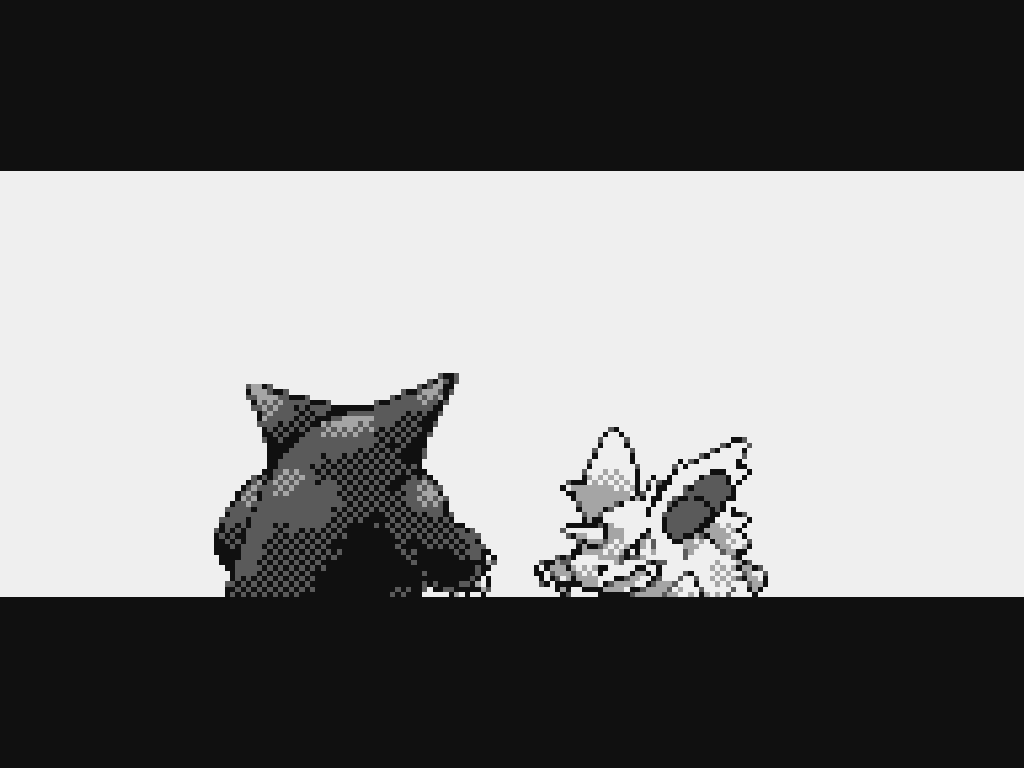
Gengar and Nidorino fighting it out.  Although the logistics of the battle make no sense, what with Gengar being a Ghost type and invulnerable to most of Nidorino's moves, we can see that...wait...

We can go further back than this....


Ah, there we go.  The original Gengar/Nidorino battle.  The first page of Satoshi Tajiri's proposal for what would eventually become Pokémon.

A Monster in my Pocket

Based on Tajiri's childhood love of bug collecting, the driving idea behind the games would be to collect as many creatures as possible. These beasts would be based on realistic and mythological elements to create a fantastical, yet familiar setting. As seen in some of the game's beta data, the earliest "Capsule Monsters" seem to stem from this idea. We have a trio of bug creatures (which seemed to influence the Weedle evolutionary line), some frog creatures that eventually became the Poliwag line, and a dragon that looks strikingly like Dragonair.


The early "Weedle" and "Poliwag" trios show that the metamorphosis-inspired evolution element was in the works from the get go (although "Poliwrath's crown" wouldn't be used as an evolutionary device until Generation II). Because these were based on animals that actually underwent biological changes, the fit seemed natural. The more spiritual "Dragonair" seems to stand on its own at this point, and isn't part of a larger family, suggesting that the evolution aspect was originally only considered for actual shape-changing animals.


The name "Capsule Monsters" or "CapuMon" were based on Japanese gashapon machines which dispensed goodies in plastic capsules. Since many monsters were planned for development, it would make sense for a trainer to have a device to carry them around in. Monsters would shrink to fit in these capsules, and could easily be stored in one's pocket. Due to the "Capsule Monster" name being in use by another company, the name was eventually changed to "Pocket Monster" or "Pokémon," and the capsules became "Poké Balls."


With so many monsters to capture, Tajiri wanted to give players the feeling that they couldn't complete this task alone. Having seen the Game Boy's Link Cable device and imagining bugs traveling along from one system to another, Tajiri knew that this device would have a role in enriching the experience of catching them all. Originally, Pokémon was just supposed to be one game, with many rare "Mirage Pokémon" serving as the catalyst to trade with friends. However, two different versions of the game were made to ensure that players had to use the Link Cable at some point if they chose to complete their collection.

Exploring the Countryside


In addition to collecting creatures, Tajiri wanted to give players the feeling of exploring the world just beyond their own backyard. Similar to the Mother/Earthbound series that was also in development, the exaggerated world of the mundane would become the main setting. Not only that, but the actual layout of the games map would be based on the Kanto region of Japan, with major cities and towns corresponding to real world locations (including starting the player off in Tajiri's own "hometown").


The towns would create a sense of familiarity to the player. A timeless aesthetic was reached as elements of many eras were folded into one. Much as Tokyo was becoming the epicenter for technological breakthroughs while the outskirts of the region remained rural and simple, so did the towns in the game balance the past and future of Japanese life. Astounding computers could perform feats only found in science fiction, yet people are forced to walk or ride their Pokémon instead of use vehicles. It was as if the inclusion of these creatures had a much greater impact on the world than simply being used for competition.


To travel from city to city, the player would have to cross oceans, mountains, and forests. Traveling through the wilderness gave a greater sense of adventure and exploration to the series, making it feel as if we really had left our modern world behind. The image of the trainer exploring a cave with his Rhydon struck me as particularly powerful as it invokes a scene akin to Maurice Sendack's Where the Wild Things Are. This is exactly the feeling Tajiri aimed for, and he succeeded, despite the graphical limitations of the Game Boy.

A New Style of RPG

Capsule Monsters was originally envisioned as a straightforward RPG, with the trainer being the lead attacker and the creatures being the support system.  A relatively small number of creatures was imagined, with Rhydon, Lapras, and Clefairy being the first creatures planned.  Rhydon and Lapras would be the heavy lifters, able to carry items/people.  In fact, surfing on Lapras has always remained the iconic water travel image, even though many Pokémon could have this ability.


Clefairy was more of a "pet" Pokémon  which allowed the developers to realize that the more creatures they could include, the more personal the experience.  Instead of building a small guild to take on a big boss, players would battle each other with completely different teams.  Pokémon would become friends with the player, and in turn the player could give them their own abilities and nicknames.  The reason the final game had only one save file was to allow people to name every single Pokémon they caught.  Ultimately, almost 200 creatures were thought up and programmed, with 150 making the final cut (151 if you include designer Shigeki Morimoto's hidden Mew).

Once the idea of collecting monsters and exploring the world with them was set in place, Tajiri's team added the final piece of the puzzle: an RPG-style battle system. The idea of creatures fighting had created some controversy from day one and it can even be seen in these early sketches that a more violent relationship between trainer and animal was intended from the start. Ultimately, the battles would be viewed as more of a form of "magical wrestling" where healthy competition and fanciful abilities were used to knock the opponent into submission.


In this series of sketches, we see images of how the battle would play out via artistic interpretations. The proto-Gastly/proto-Slowbro and proto-Blastoise/proto-Staryu battles convey the idea that the creatures are more like spirits and mythological beasts, capable of responding to human control, but also enjoying the battle themselves. Of course, Gastly always has that smile...


The proto-Mart for example shows that it sells both the capsules as well as creatures, suggesting they were envisioned as more of a pet store than a simple supply shop.   The trainer is buying the Lapras we saw earlier.  Smaller "Rhydons" are seen here, including an embryo version of one.  Perhaps these are all just placeholders for later creatures, but this bizarre market step up is definitely an intriguing "what if?" scenario.  Also, we saw earlier that a proto-Rhyhorn is walking through the town. It's unclear if the evolutionary connection to Rhydon was made at this point, as we also see similar creatures in cages and hatching from an egg in the other images.


Another major change that stemmed from these early images was the Hotel. Many RPGs use an inn as a place for the party to rest/heal completely during travels. It appears that a similar idea was to be used for the games as the female trainer is seen placing her capsules in a healing device next to her bed. This was of course changed into the more medical Poke Center, although it always bothered me that there was no places for the trainer to rest in the games. An inn would have made more sense. And, if you're familiar with your Easter eggs, you'll recall the hotel in Celadon City that is set up like a Poke Center and even holds an invisible P.C., meaning that hotels probably existed further into development than just these pictures.


Here's a great Tumblr with a lot of beta Pokemon art and analysis.

A deeper analysis with staff interviews can be found at GlitterBerri's Game Translations.

Yes, from the very beginning, the concept of Pokémon was clear.  And, after a few alterations, the game series would become the juggernaut we know and love today.