When I was 10, I began my Pokémon Journey. On September 1st, 1998, the
Red and Blue Versions were released for Game Boy and the first episode of the anime debuted in America. My very first memory of the series was a simple magazine ad that showed a collection of the creatures with the phrase "Gotta catch 'em all." Even as a child, I understood that this was a marketing ploy built on hooking kids into a large franchise, but it was so different and foreign to what I was used to that I distinctly remember saying to myself, "Pokémon? That'll never catch on."
Weeks later, I'd be eating my words. And so, with the 15th anniversary of my relationship with this series fast approaching, I've decided to go back to the beginning and actually take a look at every single aspect of the franchise. I'll be reviewing the episodes, the mangas, even the characters themselves in chronological order, basically reliving the series as it was presented to the world.
That means, for the time being, we'll only be looking at Generation I games and Pokémon So let us go back to the very beginning.
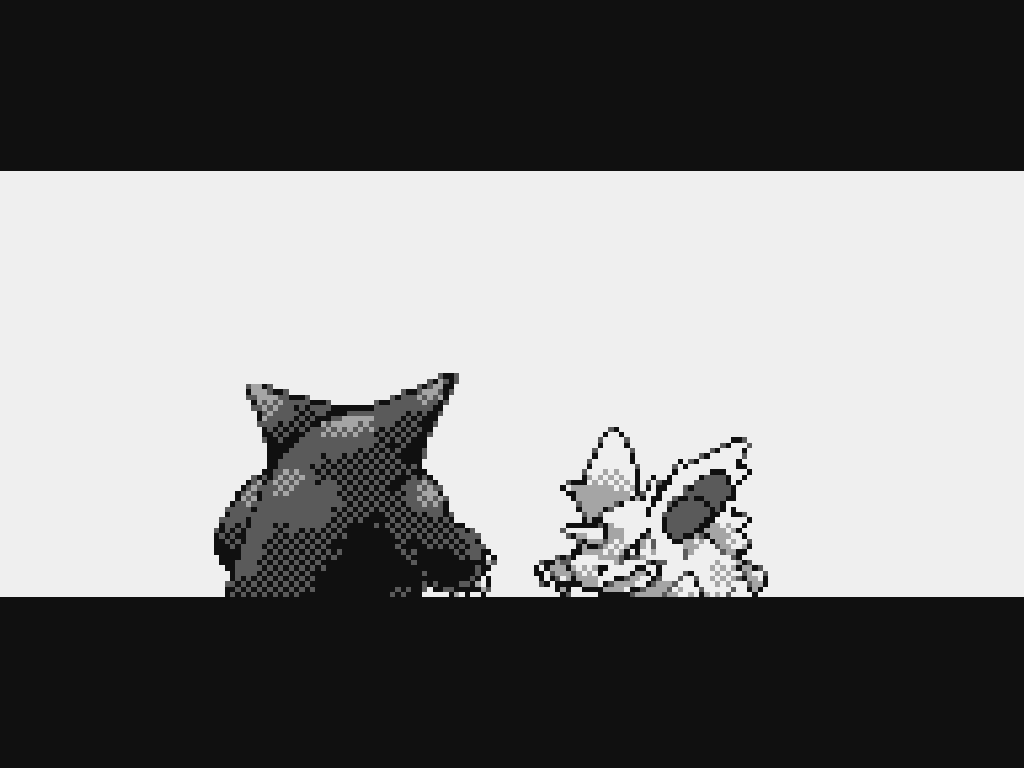
Gengar and Nidorino fighting it out. Although the logistics of the battle make no sense, what with Gengar being a Ghost type and invulnerable to most of Nidorino's moves, we can see that...wait...
We can go further back than this....

Ah, there we go. The original Gengar/Nidorino battle. The first page of Satoshi Tajiri's proposal for what would eventually become Pokémon.
A Monster in my Pocket
Based on Tajiri's childhood love of bug collecting, the driving idea behind the games would be to collect as many creatures as possible. These beasts would be based on realistic and mythological elements to create a fantastical, yet familiar setting. As seen in some of the game's beta data, the earliest "Capsule Monsters" seem to stem from this idea. We have a trio of bug creatures (which seemed to influence the Weedle evolutionary line), some frog creatures that eventually became the Poliwag line, and a dragon that looks strikingly like Dragonair.

The early "Weedle" and "Poliwag" trios show that the metamorphosis-inspired evolution element was in the works from the get go (although "Poliwrath's crown" wouldn't be used as an evolutionary device until Generation II). Because these were based on animals that actually underwent biological changes, the fit seemed natural. The more spiritual "Dragonair" seems to stand on its own at this point, and isn't part of a larger family, suggesting that the evolution aspect was originally only considered for actual shape-changing animals.

The name "Capsule Monsters" or "CapuMon" were based on Japanese gashapon machines which dispensed goodies in plastic capsules. Since many monsters were planned for development, it would make sense for a trainer to have a device to carry them around in. Monsters would shrink to fit in these capsules, and could easily be stored in one's pocket. Due to the "Capsule Monster" name being in use by another company, the name was eventually changed to "Pocket Monster" or "Pokémon," and the capsules became "Poké Balls."
With so many monsters to capture, Tajiri wanted to give players the feeling that they couldn't complete this task alone. Having seen the Game Boy's Link Cable device and imagining bugs traveling along from one system to another, Tajiri knew that this device would have a role in enriching the experience of catching them all. Originally,
Pokémon was just supposed to be one game, with many rare "Mirage Pokémon" serving as the catalyst to trade with friends. However, two different versions of the game were made to ensure that players had to use the Link Cable at some point if they chose to complete their collection.
Exploring the Countryside
In addition to collecting creatures, Tajiri wanted to give players the feeling of exploring the world just beyond their own backyard. Similar to the
Mother/Earthbound series that was also in development, the exaggerated world of the mundane would become the main setting. Not only that, but the actual layout of the games map would be based on the Kanto region of Japan, with major cities and towns corresponding to real world locations (including starting the player off in Tajiri's own "hometown").
The towns would create a sense of familiarity to the player. A timeless aesthetic was reached as elements of many eras were folded into one. Much as Tokyo was becoming the epicenter for technological breakthroughs while the outskirts of the region remained rural and simple, so did the towns in the game balance the past and future of Japanese life. Astounding computers could perform feats only found in science fiction, yet people are forced to walk or ride their Pokémon instead of use vehicles. It was as if the inclusion of these creatures had a much greater impact on the world than simply being used for competition.

To travel from city to city, the player would have to cross oceans, mountains, and forests. Traveling through the wilderness gave a greater sense of adventure and exploration to the series, making it feel as if we really had left our modern world behind. The image of the trainer exploring a cave with his Rhydon struck me as particularly powerful as it invokes a scene akin to Maurice Sendack's
Where the Wild Things Are. This is exactly the feeling Tajiri aimed for, and he succeeded, despite the graphical limitations of the Game Boy.
A New Style of RPG
Capsule Monsters was originally envisioned as a straightforward RPG, with the trainer being the lead attacker and the creatures being the support system. A relatively small number of creatures was imagined, with Rhydon, Lapras, and Clefairy being the first creatures planned. Rhydon and Lapras would be the heavy lifters, able to carry items/people. In fact, surfing on Lapras has always remained the iconic water travel image, even though many Pokémon could have this ability.

Clefairy was more of a "pet" Pokémon which allowed the developers to realize that the more creatures they could include, the more personal the experience. Instead of building a small guild to take on a big boss, players would battle each other with completely different teams. Pokémon would become friends with the player, and in turn the player could give them their own abilities and nicknames. The reason the final game had only one save file was to allow people to name every single Pokémon they caught. Ultimately, almost 200 creatures were thought up and programmed, with 150 making the final cut (151 if you include designer Shigeki Morimoto's hidden Mew).
Once the idea of collecting monsters and exploring the world with them was set in place, Tajiri's team added the final piece of the puzzle: an RPG-style battle system. The idea of creatures fighting had created some controversy from day one and it can even be seen in these early sketches that a more violent relationship between trainer and animal was intended from the start. Ultimately, the battles would be viewed as more of a form of "magical wrestling" where healthy competition and fanciful abilities were used to knock the opponent into submission.
In this series of sketches, we see images of how the battle would play out via artistic interpretations. The proto-Gastly/proto-Slowbro and proto-Blastoise/proto-Staryu battles convey the idea that the creatures are more like spirits and mythological beasts, capable of responding to human control, but also enjoying the battle themselves. Of course, Gastly always has that smile...

The proto-Mart for example shows that it sells both the capsules as well as creatures, suggesting they were envisioned as more of a pet store than a simple supply shop. The trainer is buying the Lapras we saw earlier. Smaller "Rhydons" are seen here, including an embryo version of one. Perhaps these are all just placeholders for later creatures, but this bizarre market step up is definitely an intriguing "what if?" scenario. Also, we saw earlier that a proto-Rhyhorn is walking through the town. It's unclear if the evolutionary connection to Rhydon was made at this point, as we also see similar creatures in cages and hatching from an egg in the other images.
Another major change that stemmed from these early images was the Hotel. Many RPGs use an inn as a place for the party to rest/heal completely during travels. It appears that a similar idea was to be used for the games as the female trainer is seen placing her capsules in a healing device next to her bed. This was of course changed into the more medical Poke Center, although it always bothered me that there was no places for the trainer to rest in the games. An inn would have made more sense. And, if you're familiar with your Easter eggs, you'll recall the hotel in Celadon City that is set up like a Poke Center and even holds an invisible P.C., meaning that hotels probably existed further into development than just these pictures.