Showing posts with label who's that pokemon. Show all posts

Saturday, September 28, 2013

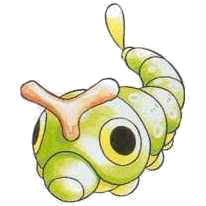
Who's That Pokémon? #011 Metapod

#011 Metapod (a.k.a. Trancell)

Although the Japaense and English names seem very different, both convey the same meaning.  Metapod is metamorphosis plus pod while Trancell is transform plus cell.  It is the cocoon stage of a bug undergoing metamorphosis.  And it can't do much while in this form.

From the Pokédex: Even though it is encased in a sturdy shell, the body inside is tender. It can't withstand a harsh attack. Hardens its shell to protect itself. However, a large impact may cause it to pop out of its shell.

Metapod can only focus on protecting the transforming Caterpie inside, so it has to strengthen its shell with Harden.  We see in Pokémon Stadium that Harden takes on a metallic appearance and sound, probably to show the effect taking place.

Generation I Moveset and Strategy

To use Metapod "effectively," you'll have to evolve it from a Caterpie so that it can keep its previous moves.  Also, it has to evolve at exactly Level 7 so that it can also learn Harden (which only works in the Yellow version).


Tackle - Normal

String Shot - Normal

Harden - Normal
Generation I Sprites
  

Metapod had a confusing design for a long time.  Because its eyes are visible on both sides, it was hard to tell which direction it was facing.  It is supposed to curve outwards, but the ridge on its back resembles a nose, making it seem as if its back was its front.  So, while I think the Yellow sprite is the best, it is facing the wrong way.  But the eyes on the Red/Green sprite are weird and the Red/Blue sprite is too bendy for a rigid creature.

Generation I Locations

Like Caterpie, Metapod is found in Viridian Forest in all versions.  Then it is also on Route 25 in Red/Green/Blue and Route 24 in Green/Blue.


We also find Metapod around the River of Pokémon Island.  We see Butterfree elsewhere on the island, but this suggests that unseen Caterpie reside in the River then migrate after evolving.

Notable Generation I Metapod

1. Ash/Red's Metapod (Anime, The Electric Tale of Pikachu, and Pokémon Adventures)


As we examined in the episode earlier this week, Ash has to project a lot of his own emotions onto the behavior of Metapod because it lacks facial expressions and speaks in a monotone.  Apparently it is upset at Ash, then heroic, but it's hard to really tell without Ash describing it.

2. Kitty (Pokémon Adventures)


Yellow's Kitty returns, this time doing its marvelous transformation to protect its trainer from a Hyper Beam attack.  It evolves again soon after this moment, but it's funny to see one of the weakest Pokémon go up against the strongest attack.  As before, this is basically the same character as Ash's Metapod.

3. Bug Catcher/Samurai's Metapod (Red/Green/Blue/Yellow, anime, etc.)


Despite most of them only knowing Harden, Bug Catchers love to use Metapod.  For some reason, they don't let them evolve.  Are they expecting to defeat opponents by only using Struggle?

Final Thoughts

As with Caterpie, there isn't much left to be said.  But, Metapods are crucial if you want a Butterfree, so you'll probably find yourself with one at some point.

Metapod's Verdict - Don't Gotta Catch 'Em (Unless You're Planning an Evolution)

Saturday, September 21, 2013

Who's That Pokémon? #010 Caterpie

#10 Caterpie

Caterpie (in both English and Japanese) is basically a shortened version of caterpillar because it is essentially a caterpillar.  More specifically, it is based on the appearance of an Eastern Tiger Swallowtail, and its Pokédex entries further this connection with the description of Caterpie's antennae.

From the Pokédex: It is covered with a green skin. When it grows, it sheds the skin, covers itself with silk, and becomes a cocoon. Its short feet are tipped with suction pads that enable it to tirelessly climb slopes and walls. If you touch the feeler on top of its head, it will release a horrible stink to protect itself. It has large, eye-like patterns on its head as protection. They are used to frighten off enemies.

This is basically all of the skills of the actual caterpillar.  Although, at least in the anime, it seems as if the large black area on the head is Caterpie's full pupil, whereas actual caterpillars only have markings to make it look like big eyes (to ward off birds).

Generation I Moveset and Strategy

Caterpie can Tackle and it can String Shot.  That's all it can do.  That's all it will ever do for this generation.


Tackle - Normal

String Shot - Normal
Tackle will mildly damage your opponent.  String Shot will slow it down.  Don't use Caterpie.

Generation I Sprites
  

The Red/Green and Red/Blue sprites are nearly identical, with Caterpie's angle turning ever so slightly. The Yellow sprite is a bit too bulky and bulgy for me, so I'll tip my hat to the Red/Blue sprite which looks the most correct.

Generation I Locations

In every version, Caterpie can be found in Viridian Forest, but they are entirely centralized there in the  Yellow version.  Caterpie are more common in Green/Blue where they appear more often in the Viridian Forest than in Red and also make appearances on Route 2, Route 24, and Route 25 (they also appear on this last route in Red as well).  Yellow had the right idea in keeping them isolated to the forest, because, if you're not going to catch it there, there is no point in catching it anywhere else.

Notable Generation I Caterpie

1. Ash/Red/Shu's Caterpie (Anime and nearly every manga)


While Rattata represented the "average young trainer starting their journey," Caterpie is reserved for the "protagonist young trainer starting their journey" as it is nearly often their first capture after the starter.  Ash's gets the most screentime while Shu's gets the most panel time (Red's capture occurs off screen, although we see him searching for it briefly).  At any rate, they are all basically there to show us that the journey has begun.

2. Kitty (Pokémon Adventures)


Sticking with the young trainer theme, Yellow catches this Pokémon all by herself, and keeps it on her team as a Caterpie for as long as she can.  Only when she is in grave danger does it force itself to evolve and protect her.  It has a similar personality to Ash's Caterpie and could be considered a spiritual counterpart.

3. Bug Catcher's Caterpie (Red/Green/Blue/Yellow and Pokémon Stadium)


While most trainers quickly catch a Caterpie and evolve it, the Bug Catchers have taken Caterpie ownership to a new level.  To mimic Satoshi Tajiri's love for collecting bugs, the young Bug Catchers are content with catching multiple of these weak creatures.  Interestingly, Caterpie is one of the few Pokémon that isn't owned by any Generation I Gym Leader or Elite Four member in any of the canon.  Perhaps it is because Bug Catchers have the monopoly on them.  It won't be until Generation II where a Bug Catcher will be elevated to Gym Leader status.

Final Thoughts

What else is there to say about Caterpie?  Sure, I always catch one out of habit.  It just seems like the thing to do.  It's always fun to have that eventual Butterfree around.

Caterpie's Verdict - Don't Gotta Catch 'Em (Unless You're an Obsessive Collector)

Saturday, September 14, 2013

Who's That Pokémon? #109 Koffing

#109 Koffing (a.k.a. Dogas)

While the initial English name for this Pokémon was "Ny" (after the smoggy skies of New York), it was eventually dubbed Koffing (as in coughing).  The Japanese name (which appears with a few Romanized spellings such as "Dogars" or "Dogasu") is based on dō for "bad" or possibly "poisonous" and gas.  It is literally a ball of poison gas, based on a floating naval mine, due to its tendency to explode spontaneously.

From the Pokédex: Its thin, balloon-like body is inflated by horribly toxic gases. It reeks when it is nearby.  Because it stores several kinds of toxic gases in its body, it is prone to exploding without warning.

Because it lives such a short, violent life, it lacks intelligence and carries a dopey, unassuming smile on its face at all times.  Apparently, the skin of a Koffing is as thin as a balloon, although in other media, he creates a metallic hollow sound when hit, suggesting a strong, thick skin.  Koffing is the anti-Jigglypuff.

Generation I Moveset and Strategy

Smog- and smoke-based attacks are Koffing's bread while his self-destructive explosive attacks are his butter.  Poison Pokémon aren't very strong in the first generation, so Koffing's best strategy includes annoying its opponent with inconveniences, and then taking it out in a suicidal blaze of glory.  Koffing is not going to be a main attacker on the team, for obvious reasons.


Sludge - Poison

Explosion - Normal

SmokeScreen - Normal

Haze - Ice

Sludge is the strongest Poison attack in the game, and it supplies a decent chance of poisoning the opponent as well.  Explosion is obviously the last resort heavy hitter with the largest amount of base damage.  Now, while a Weezing moveset relies on various elemental attacks to round out the coverage, I picked two moves to play a little more defensively.  SmokeScreen lowers the opponent's accuracy which forces to opponent to switch if they plan on hitting Koffing (and since Double-Team is a banned move for raising evasion, this is the next best thing).  Haze is only really good in Stadium where it resets all conditions of both Pokémon, including statuses and stat-modifiers.  This is to help make sure Explosion stays strong and available for Koffing when he needs it.

Generation I Sprites
  

The infamous "upside-down Koffing" plagued Americans for a long time (at least until Yellow was released).  We were unaware that the Red/Green sprite had gotten it correct and thought there was just a great constrast between the games and the anime or other images of Koffing.  Personally, the flip-flopped version has grown on me.  The other two are fine sprites, but the "mistake" has a lot of character to it.  Of course, if I had to pick one to put in the games, the original would be my pick, with its cool "smoke hands."

Generation I Locations

Koffing are only available in the Pokémon Mansion in Red/Green/Blue.  They don't even make an appearance in the wild in Yellow, due to it being one of Team Rocket's signature Pokémon.  Making their home in an abandoned laboratory fits with their accidentally-man-made nature.


However, in Pokémon Snap, a trio of Koffing live in the Cave on Pokémon Island, bothering the local Jigglypuff.  So, either they emigrated from the abandoned Tunnel, or there might actually be some naturally occurring Koffing in the wild.

Notable Generation I Koffing

1) James's Koffing (Yellow, anime, and The Electric Tale of Pikachu)


James nearly always uses his Koffing to make a quick getaway or to cover up a crime, but as his main Pokémon, it's clear that there is a lot of love between the two.  Plus, all children are familiar with his hilarious cry of "Koffing!" (My friends used to say "Coffee!" whenever mentioning the drink as a reference to this.)  He was omnipresent, even though he was just used as a prop.

2) Ken's Koffing (Pokémon Gotta Catch 'Em All)


One of Shu's many rivals in the GDZ manga, Ken is a famous guitar player who mainly uses a Koffing for distraction purposes.  It's interesting because, while I don't like looking ahead too far in the franchise, we will see another guitarist who specializes in Koffing many years from now.

3) Super Nerd's Koffing (Red/Green/Blue/Yellow and Pokémon Stadium)


Koffing appears frequently on the team of two trainer types: Super Nerds and Bikers.  But since Super Nerds tend to only use the younger variety of this evolutionary family, I'll talk about them for now.  Unlike most criminal characters who are attracted to Koffing, Super Nerds enjoy the scientific anomaly aspect of these creatures.  Combined with other artificial Pokémon, Super Nerds study the gases emitted to better understand this creature's origins and capabilities.

4) Team Rocket's Koffing (Red/Green/Blue/YellowPokémon Stadium, and TCG)


And then Team Rocket (Grunts and Scientists) just like to use them because they are poisonous and harmful to the public.  Hmm, apparently Koffing were discovered in a weapons factory.  Are they inherently evil as a result?

5) Koga's Many Koffing (Red/Green/BluePokémon Adventures, Pocket Monsters, and TCG)


Koga has a lot of Koffing.  Two in the games, and many more in other various canon.  Being a ninja, Koga probably is attracted to the SmokeScreen move, which can disguise him and allow him to move around undetected.  He's always saying that there is a link between ninjas and Poison types, but his fondness for Koffing show that he primarily likes the smoke.

Final Thoughts

For some reason, Koffing has become the mascot of two important Pokémon fansites, Dogasu's Backpack and Smogon University.  Not that I'm complaining, I just found it odd that this random (and admittedly, not very strong) Pokémon is so popular that he warrants such a fanbase.  The sites explore more in-depth analysis of the media and games, which goes against Koffing's simple nature.  I guess the old saying is true: "Every Pokémon is somebody's favorite."

Koffing's Verdict - Don't Gotta Catch 'Em (Unless He's Your Favorite)

Saturday, September 7, 2013

Who's That Pokémon? #019 Rattata

#019 Rattata (a.k.a. Koratta)

Originally dubbed "Rattatak" in English, Rattata is named after a combination of rat and attack.  The Japanese ko is added, meaning "child" or "small," signifying that this is a young Ratta (the Japanese name of the evolved form Raticate).  Despite being called a rat, Rattata is more of an average field mouse, and is one of the closest Pokémon to being a straight up actual animal.

From the Pokédex:  Its fangs are long and very sharp. They grow continuously, so it gnaws on hard things to whittle them down. Bites anything when it attacks. Small and very quick, it is a common sight in many places.  If you see one, it is certain that 40 more live in the area.  It appears to be jittery and unable to remain still.

Gnawing, speed, and an overwhelming population define Rattata, just like real mice.  These features are exaggerated in the games, via Rattata's Hyper Fang and Quick Attack moves.  And as you'll see below, you can not go two steps in a wild area without encountering at least one of these creatures.

Generation I Moveset and Strategy

Despite being based around it's sharp bite, Rattata can only learn Bite via GSC tradeback.  But it's Hyper Fang and Super Fang more than make up for it.  Like a lot of Normal Pokémon, Rattata can also learn some elemental attacks through TM, but not nearly as many as the more "supernatural" Pokémon like Clefairy or Jigglypuff.  It's best to stick with Normal attacks for this one.


Super Fang - Normal

Focus Energy - Normal

Body Slam - Normal

Dig - Ground

This is a modified version of Raticate's best moveset.  Super Fang is a must as it automatically halves any Pokémon's HP (even Ghost types), redeeming Rattata in a big way.  Body Slam is the best Normal type move it is capable of learning, seeing as how Hyper Beam is reserved for evolved forms.  To take up that empty slot, Focus Energy can be used to increase the chances of Critical Hits (as long as you use it in Stadium where the effects work, because otherwise, you should just use Quick Attack).  To handle those Pokémon that can't be hit by Normal moves, I selected Dig, which is very strong in RGBY.  Rattata's low special prevents other attacks from packing enough punch to be useful (although Bubblebeam can take down the Rock/Ground types).

Generation I Sprites
  

All of these sprites are decent, but I'm going to give the crown to the Red/Green sprite.  Maybe I'm just so tired of seeing the Red/Blue one, but I like the less threatening pose of the first one.  But the Yellow one definitely doesn't work for me.  It's just standing there, with no emotion behind its eyes.  The other two are at least active.

Generation I Locations

Rattata are everywhere.  Specifically on the grassy plains of Routes 1, 2, 4, 9, 16, 21, and 22 in Red/Green/Blue.  The Rattata population increases by over 100% in Yellow as more Rattata can also be found in Routes 3, 5, 6, 7, 8, 10, 11, and 18, as well as the abandoned Pokémon Mansion on Cinnabar Island (I guess they all hitched a ride on aboat).  They are the Zubats and Tentacools of the land.

Notable Generation I Rattata

1.  Team Rocket's Rattata (Red/Green/Blue/Yellow and TCG)


It seems that Rattatas are a staple of many Team Rocket members' teams, despite their flaws.  For an organization that is built on using the strongest, rarest Pokémon, one wonders why they use such an abundant species.  One theory is that low-level grunts must start with a Rattata and prove their worthiness to receive better team members.

2.  Youngster's Rattata (Red/Green/Blue/Yellow and anime)


The only trainer class that uses Rattata more than Team Rocket is the Youngster.  To signify weakness and immaturity, early trainers are shown with a Rattata on their team.  Even Blue had one before it was deemed too weak for his team.  But Youngsters embrace them, making them their most used species.  And yes, I'm aware of a certain infamous Youngster with a fondness for Rattata, but we'll discuss him in Generation II.

3.  Lt. Surge's Rattata (TCG)


For some reason, Lt. Surge is given a couple Rattatas to bulk up his selection in the TCG.  Perhaps it is their physical similarity to Pikachu that earned them high ranks in his army.  I personally like to think that he brought along his childhood Pokémon to remind him of the days before the war fried his brain.

4.  Bill as Rattata (Pokémon Adventures)


Depending on which canon you follow, Bill has transformed into a Nidoran, Kabuto, and Clefairy.  But it's his turn as a Rattata that is the most perilous, where his weak frame allows him to be susceptible to Fearow attacks.  I'm sensing a theme of weakness running through all of these Rattata.  Hopefully some strong ones turn up soon.

5.  The Racing Rattata (Pokémon Stadium)


In the Kids Club game "Run, Rattata, Run," four Rattata race on a treadmill that hides hurtles, somehow.  This always struck me as one of the more fun games.  It's just a lot of timed jumping, but it was adorable to watch those critters scamper!

6.  Ratty (Pokémon Adventures)


To aid a young Yellow in defending herself, Red helped her catch this Rattata, and it soon became her main partner (when Pika wasn't helping her search for Red later on).  Ratty was raised to be kind and gentle, and was able to hold its own against other trainers, even taking on members of the Elite Four!  It just goes to show that with a little love and persistence, any Pokémon can be a worthy battler.

Final Thoughts

In elementary school, for a brief period, Rattata was my favorite Pokémon.  I thought it looked simultaneously cool and cute.  I kept it as a team member for a long time, giving it a variety of elemental moves like Water Gun and Dig to keep it useful.  Then I wised up.  Sure, every Pokémon deserves fans.  But they can't all be above average.

Rattata's Verdict - Don't Gotta Catch 'Em!

Saturday, August 31, 2013

Who's That Pokémon? #112 Rhydon

#112 Rhydon (a.k.a. Sidon)

Named after rhinoceros (Japanese: sai) and don (Ancient Greek for "tooth," as used in many dinosaur names), Rhydon is a Ground/Rock Pokémon based on dinosaur with rhinoceros characteristics.  Many of the first created Pokémon were dinosaur based (including Lapras and Ivysaur) and Rhydon being the first seemed to set the standard for later creatures (note its physical similarities with Kangaskhan, Nidoking and Nidoqueen).

From the Pokedex:  It begins walking on its hind legs after evolution.  It can punch holes through boulders with its horn.  Protected by an armor-like hide, it is capable of living in molten lava of 3,600 degrees.  Shows signs of intelligence.

Clearly, the most significant attributes are its horn (used for Horn Attack and Horn Drill) and its hide (used for defense and Fire-resistance).  This explains why Blaine was given one to own in the anime, as the volcano gym would be the best place to show off its abilities.

Generation I Moveset and Strategy

Despite being classified as Ground/Rock, Rhydon only learns normal moves by leveling up.  Yet, it learns moves from a variety of different types by TM, such as Surf, Fire Blast, and Thunder.  Some consider this to be due to Rhydon being the first Pokémon programmed in the game, allowing developers to rely on it to get them through the game quickly.  However, as an attacker, it had a low special stat, meaning it's best moveset would be the following:

Earthquake - Ground

Rock Slide - Rock

Body Slam - Normal

Substitute - Normal
Earthquake and Rock Slide provide the STAB (Same Type Attack Bonus) while Body Slam hits hard and paralyzes.  Substitute takes advantage of Rhydon's high defense to add some extra wall strength.  I also like that the Substitute doll is based on Rhydon, making this a fitting move.  None of the Generation II tradeback moves improve upon this moveset, so this is the best choice, making for one of the strongest fighters in the first generation.

Generation I Sprites


Each of these sprites do a fine job of representing Rhydon, but I'd probably give the edge to the Yellow sprite.  The Red/Green Sprite has a good pose, but that giant eye is weird.  The Blue sprite is a little better, but the Yellow one is the most intimidating.  The first two are too cuddly.

Generation I Locations

Aside from evolving Rhyhorn, the best place to get a Rhydon is Cerulean Cave at Level 52 and 55 in Red/Green/Blue and Level 58-60 and 62 in Yellow.  This seems to reference the original Rhydon drawing in which we see Rhydon and his trainer exploring a cave.  It makes sense to save this appearance for the very end as a special bonus.


In Yellow, one can also trade a Golduck for one on Cinnabar Island, possibly as a reference to Blaine's volcano dwelling Rhydon from the show.

Notable Generation I Rhydon

1.  Blue/Gary's Rhydon (Red/Green/Blue and The Electric Tale of Pikachu - ET19)


Rhydon is one of Blue's final Pokémon  solidifying his status as a Champion Pokémon Trainer.  His Rhydon is the last reveal of his ever-changing team.  SPOILERS:  Blue will bring this Rhydon with him into the Generation II games and Pokémon Adventures chapters.


2.  Blaine's Rhydon (Anime - EP058)


In a surprising twist, Blaine becomes the first gym leader in the anime to use a Pokémon not of his signature type during a gym battle.  As stated, this is to show off Rhydon's resiliency in a volcanic setting, although this is also the only Rhydon that is susceptible to Electric attacks via its horn.

3.  Koga's Rhydon (Pokémon Adventures - PS007)


Koga leads some Team Rocket grunts through Mt. Moon and uses an experimental drug to induce evolution on his Rhyhorn, making it a more powerful opponent.  It couldn't be defeated by strength alone and a distraction had to be implemented to allow Red and Misty to escape.  Perhaps the forced evolution stunted its intelligence.

4.  Bruno's Rhydon (Pokémon Stadium)


While not a major player in the handheld games, Rhydon is the strongest member of Bruno's team during both rounds of the Stadium battles.  During the first round, it is armed with both Horn Drill and Fissure, meaning it has the power to OHKO anything, while in the second round, it has a moveset similar to Smogon's picks (with Surf as a wild card to take out other Rock-types).

5.  Brock's Rhydon (TCG - Gym Heroes)


Despite not using a Rhydon in the games (yet), one of Brock's holographic rares is a Rhydon that uses its thick hide to defend the Pokémon on the Bench, taking any attacks directed towards them.  That's is just like Brock to have a Pokémon that looks out for its other teammates.

6.  The Fairchild Island Giant Rhydon (Anime - EP104)


A fake giant Rhydon first appeared on Giovanni's Pokémon Land where our shipwrecked heroes found themselves in EP017.  But actual giant Rhydon lived on one of the Orange Islands with equally giant Pidgeot.  A trapped Pikachu and Meowth had to work together to defeat it, using their ability to tickle it into submission.

7.  Junk's Rhydon (TCG - Jungle and How I Became a Pokémon Card - PW14)


The story behind the rampaging Rhydon from the Jungle set is told in the story "Rhydon's Pride."  Although I don't currently have access to this particular manga, I know that Junk is a recurring character and he is the only trainer I've seen thus far whose Rhydon is serving its original purpose.  Junk actually rides his Rhydon and uses it to transport his things, just like in "Capsule Monsters."

8.  Giovanni's Rhydon (Red/Green/Blue, anime, and nearly every manga)


Giovanni seems to have four signature Pokémon   His Persian rarely battles, and his Nidoqueen and Nidoking appear the most, but he is never seen far from his Rhydon.  Unlike the Nido duo, Giovanni only uses his Rhydon in gym battles.  This is true of every canon that the Rhydon appears in, showing that Giovanni feels that it best represents his status as a Ground-type Gym Leader.  While the previous Rhydons are important, Giovanni is the trainer I most associate with the creature.

Final Thoughts

While most important Pokémon usually get some sort of personality trait, Rhydon represents the idea that these are just monsters, fighting and defending their territory.  Every Rhydon appearance is based on its girth and strength.  However, it is not an evil destroyer, but rather a helpful protector.  It's worthy of being the first Pokémon created and it's definitely worthy of being on any trainer's team.

Rhydon's Verdict - Gotta Catch 'Em!